From Pakse we said a sad goodbye to both Doro and Mathias and to Laos and flew to Siem Reap in Cambodia which is the staging point for any tours to see the temples of Angkor.
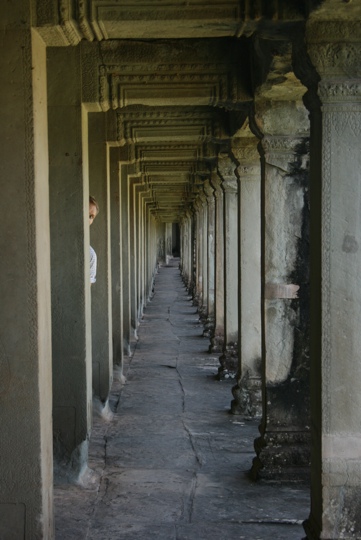
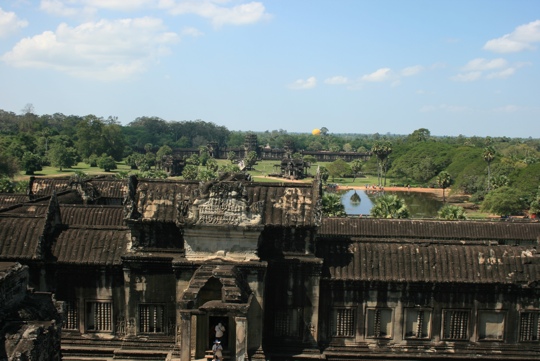
Angkor Wat is the largest religious structure in the world, the epicentre of the Khmers’ civilisation and a source of their fierce national pride. This place is the heart and soul of Cambodia and even makes it onto their national flag. Unlike the other Angkor monuments, it was never abandoned to the elements and has been in virtually continuous use since it was built in the 12th century. This was our first stop on a couple of very intensive days of templing and one for which we decided to have a guide. We were debating this decision an hour after getting out of the car as we hadn’t yet made it through the gates because was still talking! To be fair to the guy though there is obviously a huge amount of history around the construction, carvings and usage of the temples and we definitely got more out of the visit as we could pump him for information.
Angkor Wat was the first place that we’ve really run into the issue of thousands of tourists in one place and we weren’t really ready for it after the relative quiet of Laos. It did detract a little from the Angkor Wat experience to be honest, but you still can’t fail to be in awe of what the Khmers achieved in building such an incredible edifice before any modern construction methods. The sandstone blocks from which Angkor Wat was built were quarried more than 50km away and floated down the river on rafts. The logistics of such an endeavour are just mind blowing. As it’s the most famous temple and has millions of visitors each year there is constant reconstruction going on so it was a challenge to get pictures of the temple that didn’t include scaffolding, or of course thousands of tourists. Thankfully we didn’t find this at all of the temples.
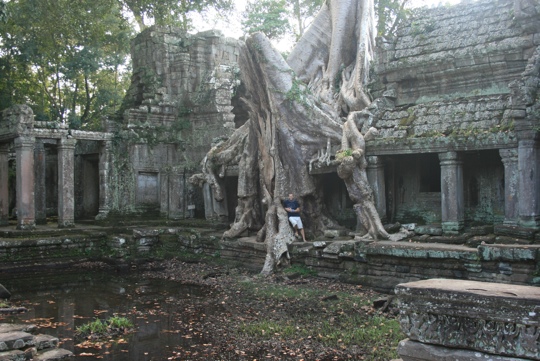
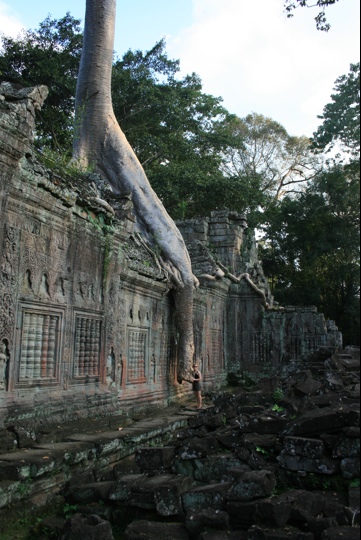
After Angkor Wat we visited Ta Prohm which I think was one of my favorite stops. This temple was again built in the 12th century but is still buried in the jungle, carpeted in moss and strangled in places by tree roots. It’s hardly surprising that it was used as one of the locations for the Tomb Raider film as it’s incredibly evocative and exactly how I imagined these temples to be.
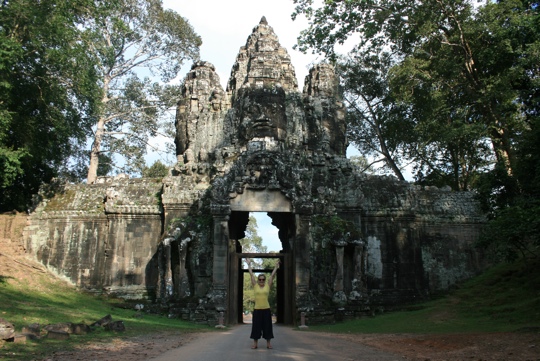
Our final temple of the day was The Bayon in the fortified city of Angkor Thom. At it’s height the city would have had a population of 1,000,000 at a time when London was a small town of 50,000. The houses, public buildings and palaces have long since decayed as they were made of wood because the right to dwell in brick or stone was reserved for the Gods, leaving only extravagant religious structures today. The Bayon itself is breathtaking, decorated with 216 coldly smiling faces of Avalokiteshvara which bear a striking resemblance to the king who built the temple – coincidence?
The following day we went a little further afield and visited Bantay Srei temple which is considered by many to be the jewel in the crown of Angkorian art. Again we encountered huge numbers of large tour groups here so we didn’t linger as long as we might have done, but the temple was definitely worth a visit as the carvings are incredibly intricate and the stone has a pinkish hue that sets it apart from the others.
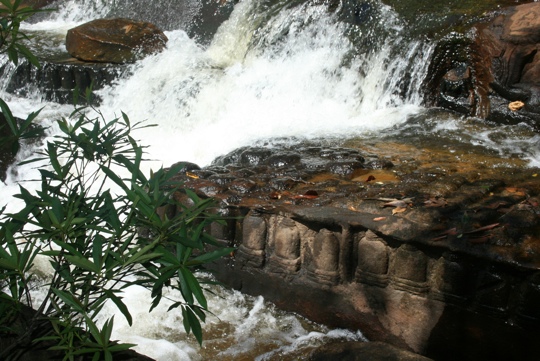
From here we headed to the Kbal Spean which is a carved riverbed about 50km from Angkor set deep into the jungle and is commonly known as the “River of a thousand lingas” – linga being the representation of the male creative energy and the motifs for the stone carvings are mainly myriads of lingams (phallic symbol of Hindu god Shiva). We really enjoyed this visit as there was a 1.5km jungle scramble to get there, it was set deep in the jungle and there weren’t nearly as many tourists presumably because you had to walk more than a few metres from the tour bus to see it.
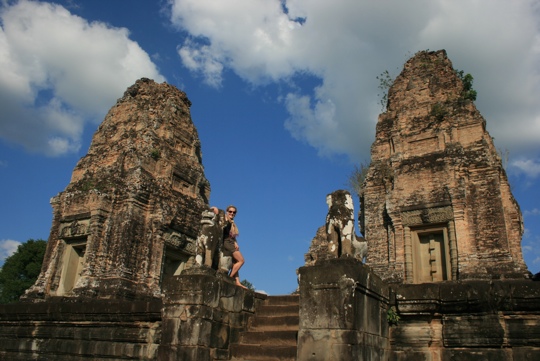
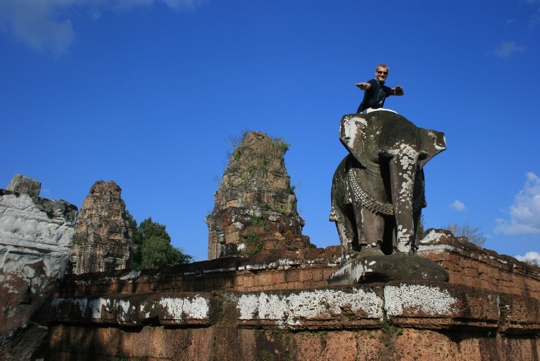
In addition to the major sites above we visited three or four more temples, all of which are incredible in their own right but sadly start to merge into each other after a while. Two and a half days of templing was definitely our limit and then it was time for some chilling out and of course, a massage before heading to Phnom Penh.
Siem Reap itself definitely deserves a mention though, because despite the fact that it seems to more or less exist to service the tourists that flock to Angkor, it has a flavour of its own with old French houses and shady tree-lined boulevards. I really enjoyed being there, especially after the rather characterless Pakse. And for people watching I really haven’t been anywhere like it!
Note: I had to include a photo of one of the religious paintings that we saw at Angkor Wat – you’ll see why below 🙂








 boltsintotheblue
Looks like you guys are having tons of fun, but it can’t compare to to Grey Cup events that are going on outside of the VC studios right now. Oh wait. Yes they can. You still win.