Hot off the heals of our temple extravaganza in Siem Reap, we decided to add a few days to our short time in Cambodia to include a trip to the capital, Phnom Penh. The main reason for this was my desire to visit the Tuol Sleng prison and the Killing Fields of Choeung Ek in a effort to learn more about the legacy of the Khmer Rouge.
I must confess that my ignorance going into Cambodia was fairly monstrous apart from a vague knowledge of the name Pol Pot as “some Asian communist dictator”. He was leader of the Khmer Rouge which was originally an indigenous rebellion force raised to help the exiled King Sihanouk regain power after a leftist revolution had seen the army’s General Lon Nol seize control in March 1970. What happened when the Khmers eventually took control of the country in 1975 has become the worst episode in the country’s history.
The mass genocide inflicted by Pol Pot’s regime on it’s own people, involved turning the country into a mass agrarian society of slave-like peasant farmers and the systematic detention, torture and execution of everyone considered to be educated, from doctors, politicians, accountants to even people who just wore glasses or who had soft hands and simply looked “intellectual”.
The Tuol Sleng prison, was originally a high school and was taken over by the regime and converted into a detention centre for some of the most barbaric torture. Classrooms were converted into cells, some no more than 6ft by 3ft in size. The school now is preserved almost exactly as it was found, complete with prisoner shackles, rusting barbed wire, instruments of torture and even blackened blood stains on the cell floors. It is a truly haunting and sombre place and a graphic reminder of these atrocities that were carried out just at the beginning of my lifetime.
Like the Nazis, the Khmers kept meticulous records of their torture, interrogation and “processing” of over 20,000 victims that passed through the prison (one of several hundred similar prisons throughout the country) in the 3 years of rule. One of the classrooms displays photographs of many of the victims, including women and children, as well as some of the Khmer guards who worked there, themselves mostly of frighteningly young ages. In the courtyard, where the school children used to play games, there are now 7 graves – these are for the only victims found (dead) when the prison was eventually abandoned, the rest were sent to the Killing Fields for execution.
The next day we hired a tuk tuk driver and headed out of the city to Choeung Ek, a former Chinese burial ground that became known as “The Killing Fields” for the mass execution of the detainees from the Tuol Sleng prison. Again, this was one of hundreds of killing fields throughout the country but has been turned into the focal point for remembering this period. After the torture of Tuol Sleng, prisoners were told they were being transferred to be released to rejoin their families and work in the fields and were loaded into trucks 30-50 at a time, still blindfolded and shackled and driven the 30km out of the city to Choeung Ek. Here they were led in small groups in front of the mass graves that had been dug and brutually murdered, often bludgeoned to death with nothing but bamboo sticks, metal bars, hoes, hatchets and other tools of the fields, this being deemed more cost effective than wasting expensive bullets.
Nowadays, the Killing Fields have been respectfully turned into a monument of remembrance to those who lost their lives there and throughout the whole country. There is a very poignant audio tour that allows visitors to walk around the grounds, now a peaceful area of fruit orchards surrounded by fields and a lake on one side, and take their own time trying to understand the horror of what went on there. Listening to this and walking amongst the multiple mass graves, now shallow hollows in the grassy areas, was without doubt one of the humblest and most moving things I have done.
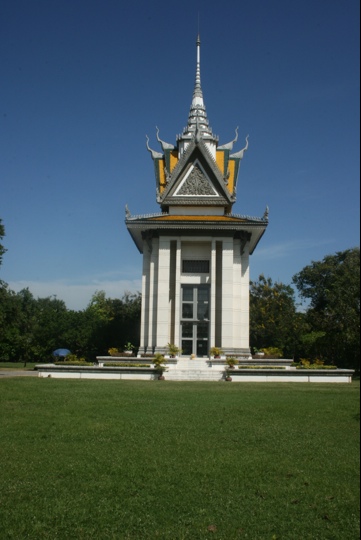
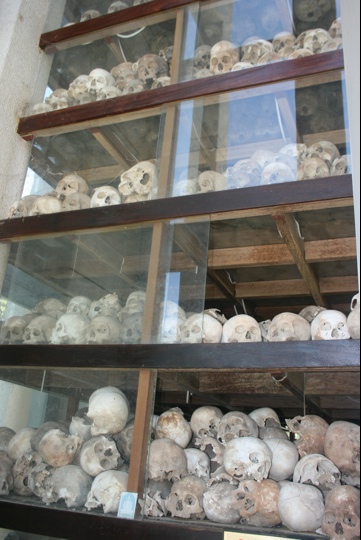
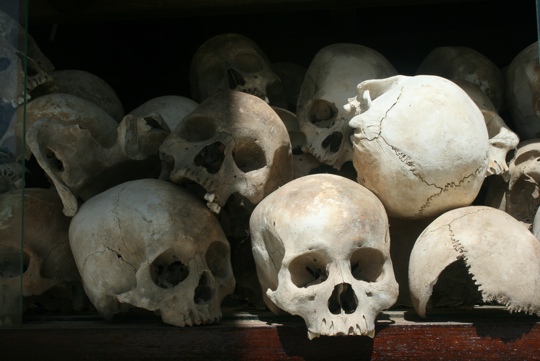
Although over 8000 bodies were exhumed from the graves for respectful re-burial following careful inspection and cataloguing of the deaths, many were left untouched and throughout the grounds you can see fragments of bones, teeth and even clothing protruding from the dusty soil as they are exposed by weathering over the years. These fragments are continuously collected by the staff but only serve as a macabre reminder of the extent of the massacres. The memorial Stupa (traditional Cambodian burial memorial) is a 100ft tall tower ornately adorned with traditional symbolic carvings and having glass walls on all four sides. Within this are stacked the skulls and major bones of the victims that have been exhumed, a graphic and haunting representation of the results of the genocide.
Leaving the site and returning to the city, we were feeling emotionally drained by the visit. It was definitely strange returning to a bustling city, full of enterprise, energy and motorized chaos and realizing that almost everyone around us would have been directly affected by the events of Pol Pots reign which actually only ended in the 80’s – estimates state that anywhere between 1.7 and 2.5 million people were killed from a population of only 8 million.
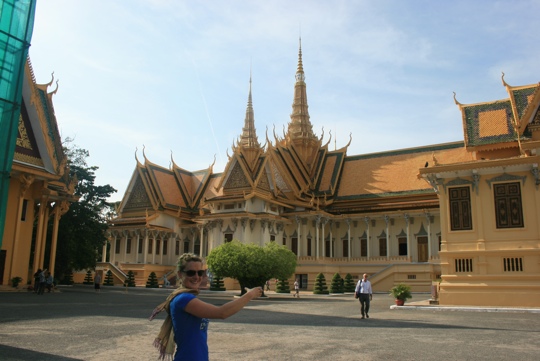
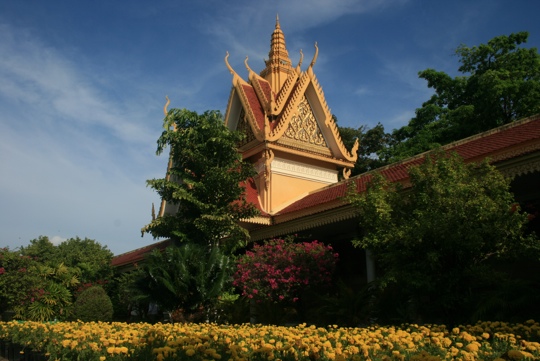
Arriving back in Phnom Penh, we tried to force ourselves out of this reflective mood by visiting the Royal Palace to remind us that the Khmer people (not to be confused with the Khmer Rouge) have a proud and civilized history outside of the Pol Pot years. The Palace itself is set in magnificent grounds of landscaped courtyards, walkways, imposing and ornate temples and pagodas and is a tranquil oasis of calm in the heart of this boisterous noisy city. The highlights included a 90 kg solid gold Buddha decorated with over 2000 diamonds and the Silver Pagoda, so called because its entire floor is laid with 5000 silver tiles weighing over 1kg each.



 boltsintotheblue
Leave a comment